Introduction to the Security Operation Center Needs
Cyberattacks are no longer a problem reserved for large enterprises. In 2026, small and mid-sized businesses face the same sophisticated threats as Fortune 500 companies, ransomware, phishing, data breaches, and insider threats, but with far fewer resources to fight back.
The question most business owners ask too late is: “Do I need a Security Operations Center?”
A Security Operations Center (SOC) is a centralized unit of cybersecurity professionals who monitor, detect, investigate, and respond to threats across your entire IT infrastructure, 24 hours a day, 7 days a week, 365 days a year. If your business is showing any of the warning signs below, the honest answer is: yes, you need one right now.
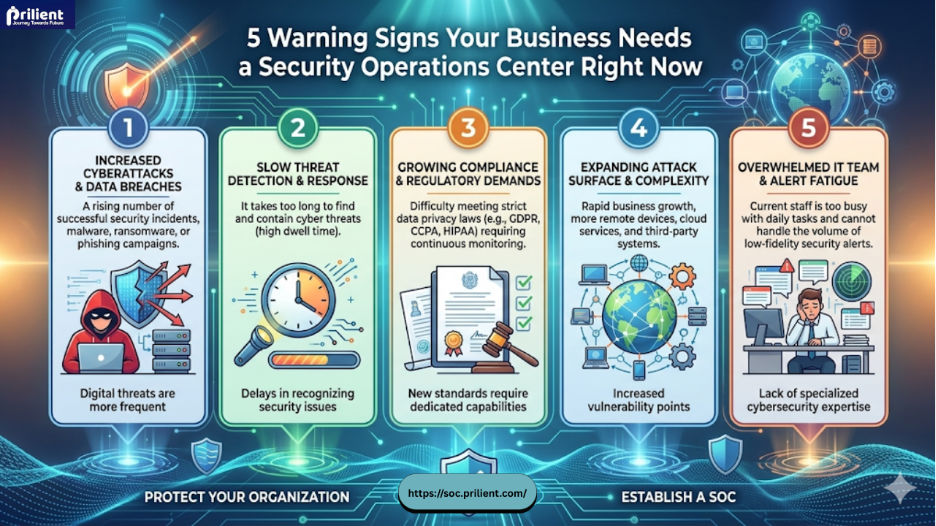
Do Not Ignore These 5 Warning Signs About Your Business Cybersecurity…!
1. No 24/7 Threat Monitoring in Place At Your Business
Cybercriminals are not IT employees. They don’t work from 9 to 5. The majority of cyberattacks are deliberately launched during off-hours nights, weekends, and off days when IT teams are unavailable, chilling on holidays, and defenses are weakest.
If your business lacks round-the-clock network monitoring, you’re essentially leaving your front door unlocked every night. Without continuous visibility across your endpoints, cloud environments, and network traffic, threats can go undetected for weeks or even months.
A managed SOC provides real-time threat detection and immediate incident response. No gaps, no downtime, no blind spots.
2. Your Cybersecurity Team Is Overwhelmed by Security Alerts
Modern security tools generate hundreds, sometimes thousands of alerts every single day. Without a dedicated team to triage, investigate, and prioritize these alerts, your IT staff quickly suffers from alert fatigue, causing genuine threats to be missed or dismissed as noise.
If your team is spending more time managing false positives than resolving threats, it’s a clear signal that you need a dedicated SOC team. A professional Security Operations Center uses advanced SIEM (Security Information and Event Management) technology combined with skilled analysts to filter out the noise and focus on what truly matters.
3. You’ve Already Experienced a Data Breach or Security Incident
If your organization has suffered a data breach, ransomware attack, or any form of cybersecurity incident in the past, the risk of it happening again is significantly higher. Attackers often return to previously compromised targets.
More critically, most businesses don’t fully understand how the breach occurred or how far it spreads, leaving vulnerabilities wide open for repeat exploitation.
A SOC doesn’t just respond to attacks; it conducts deep forensic investigation, identifies the root cause, closes the gaps, and implements proactive threat of hunting to prevent future incidents. Without this level of analysis, you’re simply patching a wound without removing the splinter.
4. You Handle Sensitive Customer or Financial Data
If your business stores, processes, or transmits sensitive data, customer records, payment information, health data, or personal identifiable information (PII), you are a high-value target for cybercriminals.
Beyond the reputational damage, a breach involving this type of data can expose your business to serious regulatory consequences under frameworks like GDPR, HIPAA, PCI DSS, and India’s DPDP Act. Regulatory fines alone can be devastating for a growing business.
A managed SOC helps you maintain continuous compliance monitoring, generates the audit-ready documentation regulators require, and significantly reduces the risk of a costly compliance violation.
5. Your Business Is Growing Rapidly but Not Your Cybersecurity
Rapid growth is exciting, but it expands your attack surface just as fast. Every new employee, new device, new cloud application, or new third-party vendor integration introduces a potential vulnerability.
If your business is scaling quickly, migrating to the cloud, adopting remote work policies, or integrating new technology, your security posture needs to scale with it. Most in-house IT teams simply cannot keep up.
A SOC as a Service model, like the one offered by Prilient, scales with your business needs. You get enterprise-grade cybersecurity protection without the cost and complexity of building an in-house security operations center from scratch.
How Prilient Managed SOC Services Can Help
At Prilient, we specialize in delivering comprehensive Managed SOC Services designed for businesses of all sizes. Our team of certified cybersecurity professionals, including CISSP-qualified analysts provides
- 24/7 security monitoring
- Real-time threat detection
- Rapid incident response
- Full compliance support.
Whether you’re a growing startup or an established enterprise, our SOC as a Service model means you get the full power of a world-class security operations center without the overhead of building one in-house.
No long recruitment cycles. No million-dollar infrastructure investments. Just expert protection, from day one…!
At the End: Don’t Wait for an Attack, Act Now…!
The average cost of a data breach in 2026 has crossed $4.8 million globally. For small and mid-sized businesses, a single significant breach can mean permanent closure.
If your business identified with even one of the warning signs above, it’s time to have a conversation about your cybersecurity posture.
Contact Prilient today for a free SOC assessment and find out exactly where your vulnerabilities lie — before an attacker does.
Frequently Asked Questions
Q1. What is a Security Operations Center (SOC) and does my small business really need one?
Ans. A Security Operations Center (SOC) is a dedicated team of cybersecurity professionals who monitor, detect, and respond to threats across your IT infrastructure around the clock. Remember if your business handles customer data, processes payments, or depends on digital systems to operate; a managed SOC service is not a luxury, it’s a necessity.
Q2. What is the difference between a Managed SOC and an in-house SOC?
Ans. An in-house SOC means hiring, training, and retaining a full internal team of security analysts along with the infrastructure to support them, which can cost upwards of $1–2 million annually.
A Managed SOC, like the one offered by Prilient, gives you the same level of 24/7 threat monitoring, incident response, and compliance support at a fraction of the cost
Q3. How quickly can a SOC detect and respond to a cyberattack?
Ans. We believe speed is everything in cybersecurity. That’s why at Prilient, our SOC analysts operate 24/7 with defined response playbooks.
It means the moment a threat is identified whether ransomware, a phishing compromise, or an unauthorized intrusion, our team acts immediately to contain it and minimize impact on your business.